Before we started doing this CSA thing a few years back, I had never even heard of kale. I'm familiar enough with it now, but I still seem to always make the same thing with it. It's a sesame kale recipe which basically involves boiling it and then frying it up with garlic, tamari and some toasted sesame seeds. It's really good. Sometimes it's even great. But it gets old.
So what the hell do you do with kale? Does anyone have a really good recipe for kale chips? I tried those once this spring and was underwhelmed.
And here are a few ideas of what you can do with turnips, submitted by the awesome readers of my adequate blog.
Erin tried turnip fries, too, but hers were a success instead of a crushing failure like mine. She coated them in canola oil, topped with salt and pepper and roasted for 20 min in 450 degree oven.
Sayward said, "I've only ever done turnips one way - the traditional Scottish 'bashed neeps and tatties', which is basically turnipy mashed potatoes. They were absolutely delicious served with a homemade vegan haggis and whiskey reduction gravy. I blogged about it here."
On Facebook, Bill said the only thing he's ever done with them was put them in a stew.
Donna said that she throws them in stews and soups, too. She also eats them raw. Also, mashed with some Earth Balance. Oh, and the greens sautéed with lots of garlic. She says greens are the best part of the turnip.
I have a horrible habit of never getting around to using the greens on top of things like turnips. Note to self: change that bad habit.
Heidi suggested Irish Colcannon.
And Kris said, "Roast them in olive oil with potatoes, sweet potatoes, carrots, garlic and rosemary for a rockin' root vegetable medley."
Thanks for the suggestions!
We did get turnips in our most recent box (still no radishes though), and tonight I made bashed neeps and tatties for two reasons, 1) It's easy and I already love mashed potatoes and 2) I really like saying (and writing), "bashed neeps and tatties." I didn't make Sayward's vegan haggis and gravy though. Maybe next time.
All right. Now kale. What the hell do you do with kale?
Actually, first of all, I'm going to post everyone's ideas on what to do with Radishes from last week. Unfortunately, I ended up eating all of ours raw before getting the chance to try any of these out, and then we didn't get any in our most recent box. Hopefully we'll get some this week (if you were to tell myself 10 years ago that ten years in the future I would want to eat radishes, I would have called you a crazy liar).
Jacqueline did this: "Just very thinly slice them up, toss with a tad of olive oil, lay out a single layer on a baking sheet and bake them at 400 degrees for about 10-15 minutes, watching that they don't burn." I think this is the one I'm going to try first if we get more this week. I love chips of any sort and these sound really good. I'll probably end up adding a bit of salt.
Achim had this recipe for radish soup: "Mainly the green leaves are used. Peel and dice 2 potatoes and 1/2 onion. Cook for some 20 min in 2 c vegetable broth. Chop radish greens, add it to the soup, blend it in a food processor or something, add 1/2 c soy milk and some salt (if necessary). Let some thin radish slices hover on the soup."
Lisa makes dressing, "with a couple radishes, some, olive oil, agave, garlic, and red pepper flakes whirred up in a blender. Spicy!"
Tara (or Nate?) at Vegan Piggy made a tabbouleh out of The Kind Diet and blogged about it here.
Mangocheeks (great name, by the way) also enjoys them raw, dipped in salt and chili powder.
The Voracious Vegan likes them roasted, but also raw and in a salad. I like that idea. Salads don't usually do it for me, so then I have to smother them in dressing in order to get the level of flavor I like. But I could imagine radishes doing that trick, too.
A couple friends on Facebook also said they love radishes roasted.
And finally, my friend Heidi on Facebook said to, "Smear them with fresh butter and sprinkle with coarse salt." I'll opt for soy butter, of course, and it sounds delicious.
Thanks for all the ideas!
And now on to turnips.
Here's what I did with the turnips we got:
Don't those look delicious? Well, they weren't. They tasted way to turnipy. Yes, turnipy.
I used this recipe online and I don't know, maybe I didn't bake them long enough. They weren't crunchy at all and they didn't taste that great.
So hit me with it. What the hell do you do with turnips?
"I want a rubber band, Daddy," says my almost four year old daughter.
"Why?"
"For my monkeys."
"Why do you need a rubber band for your monkeys?"
"Because I'm going to kill them."
Calm down. Deep breath. Aaaaaand, overreaction!
"We don't pretend to kill animals," I say, knowing full well that we do, indeed, pretend to kill animals. I pretended to kill animals (mostly humans) all the time when I was a kid. It's what kids do.
Did you have a cap gun growing up? Did you pretend to have shoot-outs with your siblings and/or friends? It's make-believe. It's dragon slaying. It's, "I'm Luke Skywaker and you're Darth Vader." It's (not necessarily, but often) a developmentally appropriate part of childhood.
Kids explore taboos, danger and the idea of good vs. evil through make-believe. It's an important way they process the unfamiliar things that they see and hear.
A couple weeks ago, Anna went on a boat ride. Before the boat ride, two of her uncles were fishing. She asked on the way home what they were doing on the boat when we weren't there, so we told her. I get the feeling that her knowledge that these two uncles she loves were out trying to kill fish before they took her on the best boat ride of her life has something to do with her recent pretending to not be vegan. It's a safe, harmless way for her to process the idea of killing animals to eat them.
As an aside, I realize that many vegans probably think that killing animals isn't an idea that kids should have to process. We oppose it, so why should we allow kids to pretend to do it? Well, I think we should for the same reason that we should let them play cops and robbers; for the same reason there's no harm in them picking up a stick and battling a tree that they're pretending is a mean person or a monster. Kids need to learn the difference between make-believe and reality, and they need to process all that they see. They're either going to internalize everything or they're going to express it. I think expressing it (in a way that doesn't hurt anyone) is the healthy way to go.
All of this was running through my head after I said we don't pretend to kill animals. And I decided that she can, indeed, pretend to kill animals. You'd think I would have been prepared for this, since Jen went through this same scenario with Anna about a week ago and we talked about it and said that it was OK. But when your daughter says to your face, in that cute little voice of hers, that she wants to kill monkeys, well, I think I'm allowed an overreaction here and there.
A few minutes later we sit down to the dinner table and Anna pulls out the pretend food. I get an orange with ketchup, Jen gets a lemon with ketchup, and Anna gets a barrel of monkeys (no ketchup). She startes tying them up, one after the other, with a rubber band and then never really pretends to eat them, but says she's eating them.
"So, what's the deal with the rubber band? What are you doing to them?
"I'm tying it up," she says.
"It?" I say, "Don't you mean her? Or maybe him?"
"Her. She's a big sister! She has a little brother."
"How do you think her little brother will feel about you eating his big sister?"
"I'm going to eat him too! I'm going to eat all of them!"
Jen and I just laugh. I try to say something about the monkeys' cousins in the next town, but it's a lost cause.
"We don't actually eat monkeys though, right?" I have to check. Just to make sure.
"I know. I'm just pretending," she says with that little shoulder shrug and slight pursing of the lips that says, "Chill out Dad. This isn't a big deal."
The other day she "prepared" a veggie burger for her, Liam and me. Mine and Liam's were both vegan with vegan sour cream, but hers had non-vegan sour cream on it.
I think we're just going to roll with all this stuff for now (as if we have a choice). It's either that, or kill make-believe. And we don't want to kill make-believe.
So I thought that each week I'd pick something from the CSA box and write about what I do with it, how it tastes, why it's good for you. You know, stuff like that.
I'm going to call this project, "What The Hell Do I Do With..."
And this is going to be as much for me as it is for you, dear reader (can I call you "dear reader"?). This is the third (or is it fourth?) year we've done this CSA thing, and I still have no idea what to do with, for example, kohlrabi. Seriously.
So I'm going to say what I do with stuff, but then I want YOU to tell ME what YOU do with it.
So first up: Radishes.
Honestly, I just eat these raw. Wash them off. Scratch off any dirt that doesn't wash off (unless you like dirt, which hey, more power to you if you do). And then eat them raw with nothing on them (though I suppose a smidgen of salt might be nice).
This is how my family ate radishes growing up. I don't remember them served any way other than a bunch of raw radishes, straight from the garden, washed and in a bowl on the table.
I hated them.
I hated most vegetables and fruits growing up. I don't know why, and I'm thankful that my children don't have the same aversion I did. Though if I could grow up passably healthy eating nothing but meat and grains, I'm sure my kids could grow up healthy eating nothing but beans and grains. And then in their twenties they'd start eating fruits and vegetables again once they they realized that they were missing out on a WHOLE WORLD OF FLAVOR (I'm in an all-caps (and parenthetical) mood. Sorry.).
So, radishes. They're high in vitamin C, folate and potassium. And they have this really great spice thing going on, sort of like wasabi (which makes sense, since they're both members of the Brassicaceae family, thankyouverymuch Wikipedia). It's the kind of spiciness that doesn't hurt your mouth, but sort of makes your nose tingle.
I love them.
And while I'm sure that eating them raw is the best way to make use of their nutritional value, I wouldn't mind actually preparing radishes in some way that doesn't just involve running cold water over them.
So please let me know what you do with them in the comments and I'll post some or all of the replies along with next week's installment of ... "What The Hell Do I Do With..."
Here are some photos from yet another trip to the Children's Museum of Minnesota.
Pony tail before we leave the house.
The first thing the kids usually see is the face-painting station. Anna really took to it this time. Liam, too.
There was a dinosaur exhibit this time around. I thought Anna might be afraid, but she loved it. I think the reason kids love dinosaurs is that they aren't around anymore. They're these huge monsters, basically, and you'll never ever see one in real life (well, I probably won't, but she might if they're ever brought back a la Jurassic Park). But they were real!
If you stand perfectly still, he won't be able to see you.
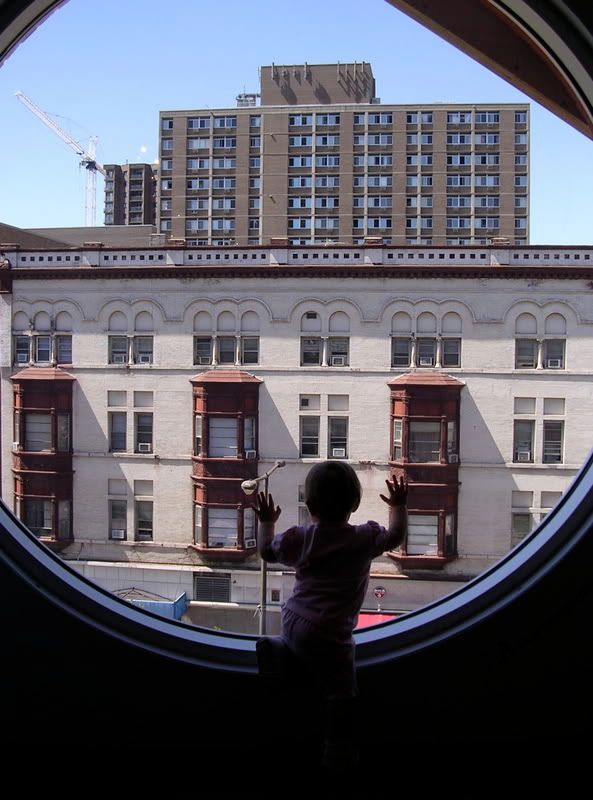
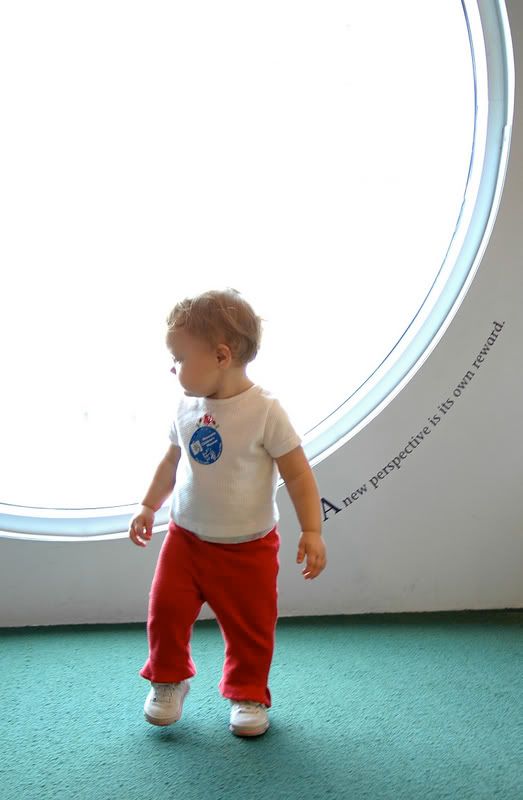
And here it is again, my favorite window in Saint Paul, MN.
If I can digress for a bit here, I've always loved taking photos of the kids in front of this window. I just love the big circle and the fact that it's so much lighter outside than it is inside. It's a pain in the ass, because the kids are always back-lit, but I see it as a challenge. And I never seem to face that challenge the same way as last time. Here are some other photos of them in front of the window, not from the most recent trip.
This is Anna in August '07.
Anna in October '07.
Liam in November '09.
Anyway, that's just a taste of them. There are a lot more, but I'd have to crack open the external hard drive and, well, there are more photos to show from our most recent trip. So, back to present day:
I wrote a long post about this and it somehow got deleted and I don't think I have it in me to write it all out again. I'm going to sum it up now.
Photos of the birds suffering and dying in oil are horrible. I agree.
I've seen these photos linked on Facebook quite a bit recently. It makes me sad too and I understand the urge to post the photos and make sure others know what's going on.
It's important to share in the communal outrage.
I feel that outrage. But I also feel something else.
On one hand, it's frustrating to see outrage over the photo on the left and silence when it comes to the photo on the right.
On the other hand, the amount of concern for the animals affected by the oil leak proves that people can and do care about animals even if they don't personally know them. This gives me hope. I wish that everyone could connect the dots and realize that the animals we exploit on purpose are every bit as sentient, thinking and feeling as the Brown Pelican drowning in oil.
There is no moral distinction between the bird on the left and the birds on the right. Both deserve the right to live free from unnecessary suffering and death. Both deserve our consideration and sympathy and empathy. Both live(d) brutal existences (one accidental, one intentional) caused by humans.
The big difference between these two situations is that one is an accident and other is on purpose. Billions upon billions of animals unnecessarily suffer and die every year on purpose.
Which do you feel worse about? But more importantly, why?
Mumble the emperor penguin, in a zoo, yelling at humans: "Hello! Hello from Emperor Land. Good afternoon. Why are you taking our fish? I'm sure you don't mean to, but you're causing an awful lot of grief. Am I not making myself clear? I'm speaking plain penguin. Penguin! Don't you understand? You're stealing our fish! Please! Anyone! Talk to me! For pity's sake, you're stealing our F-I-S-H!"
Voiceover: "After 3 days he would lose his voice. After three months, he would all but lose his mind."
And that right there is when I fell in love with the movie Happy Feet. It took the movie over an hour to get there, but this scene... Whew! The protagonist, Mumble, is in a zoo, put there after he's found on a beach. A beach he ended up on after swimming after a fishing barge. A fishing barge he swam after because he wanted to tell the "aliens" to stop taking their fish. The "aliens" who were taking their fish because, well, why do we eat fish again?
Right after the voiceover tells us Mumble all but lost his mind we see him with the other penguins, swaying back and forth with a vacant look in his eyes, mouth open as fish are thrown over a ledge and down to the penguins.
Anna was watching this scene with a friend of hers the other day and she said, "This is a happy and sad part."
I asked her why it was happy and sad.
"It’s sad that he’s in a cage and it’s happy that he gets fish."
I was pretty proud of her for recognizing that something could be happy and sad at the same time. And yeah, free fish falling from the sky could be seen as a positive aspect of zoo life. But at what price? Penguins can't really be penguins when they're stuck in a zoo.
And of course, the movie (being a kid's movie) gives us a simplistic view of things. The fish in the ocean aren't any more the penguins' as they are the humans'. Nobody owns the fish. The fish aren't possessed by anyone (that is, until they're captured or eaten).
Here's how I explain it to Anna:
Penguins need fish to live. Without eating fish, penguins would die. They have no choice. Fish don't want to be eaten, but penguins have to eat them to live.
People do not need fish to live. Without eating fish, people live long, healthy lives. We have a choice. Fish don't want to be eaten and we don't have to eat them to live.
She understands this. In fact, she seems to completely grasp the concept.
At the end of the movie the "aliens" decide to stop fishing (at least in the area around Antarctica) and the fish's numbers grow and the penguins' famine is over.
When this happens, Anna's gets happy. She has no aversion to carnivores. She sees nothing wrong with a penguin eating a fish and I see nothing contradictory about that fact.
It's all about choice and the ability to choose. And I'll write more about this in a future post. Specifically, I'll write about how I've explained non-human omnivores to her. For example, bears eat plants and fish. But if they can live on plants, then why do they eat fish? It seems like we intuitively know the answers to questions like these, but try explaining it to an almost-four-year-old.
It's not easy, but it sure is fun.
Anyway, a little more about Happy Feet. There's a part where a leopard seal chases Mumble with the intention of eating him. This is a little harder to explain to Anna, since she's rooting for Mumble to escape. Here we get into the complexities of narrative a little more. The leopard seal is portrayed as a "bad guy", but on the face of it, he's just trying to eat what he needs to eat to live.
Leopard seals eat penguins, penguins eat fish. Who we root for is dependent solely on the story. In a few years, Pixar will come out with a touching movie about leopard seals and we'll all root for them to catch the penguins.
My point is that accepting and appreciating the need for some animals to kill and eat other animals to survive does not contradict an animal rights position. The animal rights position is dependent upon the fact that we as humans do not need to exploit animals in order to survive. We don't need to eat or wear their flesh, we don't need to drink their lactations and we do not need to scramble their menses every Sunday morning. It's all unnecessary.
If it were necessary; if we needed animal products to survive - if we could not survive without them - then there would be no animal rights movement. There may still be an animal welfare movement though who would say (as they pretty much do now) we should still own, rape, exploit and kill animals because we have to ... but do it a little nicer, m'kay?
Luckily for us and for those exploited non-human animals, there's another way. We can live just fine by eating plants.
But this was supposed to be a review of Happy Feet. Let me just say that there are a couple overtly and covertly sexual parts to this movie. Just so you know. I mean, it's nothing that big. Just stuff like one penguin saying, "Gloria! Gloria! I want to see more of ya!" And there's some talk of making love. There's this one quick scene where, no joke, two penguins are stumbling over each other on the ice and manage to hit all the major sexual positions. I don't think Anna picks up on a lot of that stuff, but even if she does I'm not too worried. We're open about the biology of sex with her.
In fact, just the other day I heard her saying to Liam, "Do you see birds outside, Liam? Are they having sex, Liam?" Then she asked us what sex was again, I explained it to her and she then explained it to her baby doll.
Oh, and there's a nice "rational thinking trumps superstition" theme that comes into play at the end of the movie. Have I mentioned that I love Happy Feet?
It's a musical, too. There's a ton of music and dancing in it, which is why I think Anna considers it her favorite movie. It's a movie and a work-out for her. I'm actually quite sad that they don't make more musicals these days. And I'm looking forward to the day when she's old enough to watch West Side Story. Mambo!
Well, I'm rambling. I'm going to reward you now for sticking with me for this long. Here's a video of Anna dancing to the end of Happy Feet. The video didn't pick up the sound of the movie, so I threw in a song by Malajube.
So, have any of you seen Happy Feet?
Vegans, how have you talked about the movie with your kids?
Then there's, Want to Go Green? Eat Less Meat, which focuses on Gene Baur and his organization, Farm Sanctuary, an organization that I have my qualms with. I love Farm Sanctuary's sanctuary program, but have my problems with their focus on improving animal welfare instead of abolishing animal use. I met Gene a few years ago and he's a nice guy. We had a good discussion about my qualms and, while I didn't leave convinced that welfarism is a valid way to advocate for animal rights, I came to realize that his heart is, of course, in the right place. We don't necessarily differ in regard to our goal, but in the way in which we advocate for that goal.
Anyway, I liked most of what he had to say in this article.
"Switching to energy-efficient light bulbs, carpooling, recycling — these are all great ways we can lessen our carbon footprint," says Baur, "but when compared with the difference you can make simply by eliminating or reducing meat and animal products from your diet, other aspects of green living pale by comparison."
Next, there's This Earth Day, Go Vegan from The Guardian which, unfortunately, repeatedly links to PETA. But other than that it's pretty good. Some highlights:
In Livestock and Climate Change, the Worldwatch Institute estimates that raising animals for food actually accounts for 51% of all greenhouse-gas emissions.
-
A totally vegetarian diet can be produced with only 1,100 litres of water per day, while producing a diet that includes meat requires more than 15,000 litres of water per day.
-
Our meat-based diet is partly to blame for world hunger, because land, water and other resources that could be used to grow food for human beings are used to grow crops for farmed animals instead. It takes up to 16 pounds of grain to produce just one pound of meat.
And here's Veganism: Morality, Health, and the Environment, a post from Gary Francione that illustrates how we can't really separate our caring for the environment and our caring for animals, including ourselves.
And finally, Livestock and Climate Change by the Worldwatch Institute, an independent research organization that, "focuses on the 21st-century challenges of climate change, resource degradation, population growth, and poverty by developing and disseminating solid data and innovative strategies for achieving a sustainable society."
Some of you may remember the Food and Agriculture Organization of the United Nations paper called Livestock's Long Shadow. It was a page turner, let me tell you. Well, what the Worldwatch Institute did was take the FAO's paper, apply reality to it, and come up with different numbers.
Livestock are already well-known to contribute to GHG (greenhouse gas) emissions. Livestock’s Long Shadow, the widely-cited 2006 report by the United Nations Food and Agriculture Organization (FAO), estimates that 7,516 million metric tons per year of CO2 equivalents (CO2e), or 18 percent of annual worldwide GHG emissions, are attributable to cattle, buffalo, sheep, goats, camels, horses, pigs, and poultry. That amount would easily qualify livestock for a hard look indeed in the search for ways to address climate change. But our analysis shows that livestock and their byproducts actually account for at least 32,564 million tons of CO2e per year, or 51 percent of annual worldwide GHG emissions.
And they back that up with a lot of numbers. Be warned. There are a lot of numbers. But it's worth the read, at least up until page 15. After page 15 they get into marketing stuff and focus too heavily on soy as the supposed magic bean to save the world. Don't get me wrong, I like soy. And I guess from a "way to convince people to stop killing the earth" standpoint, soy is pretty versatile. What with the analogs and all.
At any rate, I personally don't think that there's some sort of line you have to draw in the dietary sand when it comes to being an environmentalist. These things are all graded on scale, and a drastic reduction in your animal and animal product consumption would, without a doubt, translate into a drastic reduction in your carbon and water footprint. So, for the environment, I would say that we should all drastically reduce our animal and animal product consumption, preferably to nill.
For the the non-human animals we eat and wear, on the other hand, I'd have to say that we should go vegan.