Showing posts with label Confronting Animal Exploitation. Show all posts

Wednesday, June 12, 2013

ARZone Podcast

Well hello there! 

Just thought I'd let you all know that I'm on the most recent ARZone podcast

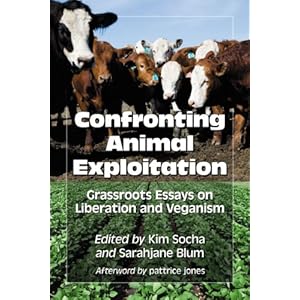
Carolyn Bailey and Tim Gier asked me some really great questions about my essay in Confronting Animal Exploitation and about vegan parenting in general. I also give a really long answer to "The Ronnie Question," which basically lays out my entire vegan history. 

This is the second podcast I've been on now, and I actually quite enjoy it. I'm amazed again at how coherent and knowledgable I sound. Sure, I'd change some things if I could. But for the most part, I'm happy with how it turned out. It shouldn't go without saying that Tim's editing skills likely have a lot to do with how pleased I am at the result. 

So click here and then choose a way to listen to it. And let me know what you think! 

Also, if you've read my essay in Confronting Animal Exploitation, I'd love to hear any feedback you have. I'm so used to the internet where people can tell me if they like or dislike what I've written right after reading it. It feels odd to have put such a substantial piece of work out there and for people to have no direct and immediate way to let me know what they think of it. So humor me if you can, m'kay? 

Until next time...

Wednesday, February 27, 2013

Living up to the Lessons We Teach our Children - an excerpt from Confronting Animal Exploitation

Here's another excerpt from my 23-page essay in Confronting Animal Exploitation, officially due out April 1st (though it looks like you can put it on a Kindle or a Nook right now if you wanted to).
The late Stanley Sapon, professor of psycholinguistics at the University of Rochester, said, “we typically raise children from birth to five or six years in a kind of fantasy-land of ideal behavior on the part of the world’s inhabitants … a ‘land of goodness and mercy,’ a land where the animals are our friends, and we are the friends of the animals.”

Children under a certain age are not taught that other-than-human animals are here for us to exploit and kill. Instead, representations of these beings are used in children’s media to illustrate life lessons, as in books like Chicken Little and The Three Billy Goats Gruff. Other stories also teach us that other-than-human animals should be spared suffering and death—as is the case in Bambie—and should live free from captivity and have their intrinsically valuable lives respected by others—a major theme of, for example, the children’s movies Free Willy and Rio.

Vegans parents take these lessons to their logical conclusions and teach their children to not only say that animals are our friends, but also act as if they are. It’s not enough to say, “Be nice to animals.” We need to actually be nice to all animals. Chicken dinner, steak on Fridays and eggs for breakfast run counter to this message.

Friday, February 15, 2013

Vegan Kids Rebelling Against Their Parents? - an excerpt from Confronting Animal Exploitation

April 1st! That's the official publication date of Confronting Animal Exploitation. To celebrate the impending release of this book, I'm posting an excerpt from my essay, Vegan Parenting: Navigating and Negating Speciesist Media, which appears in a section of the book titled Veganism in Action.

As the title suggests, my essay centers on speciesism in children's media. But the essay also includes a section that focuses on attitudes which undermine vegan parents and a section in which I outline some practical advice on how to talk to our kids about veganism and speciesism. This excerpt is from the section about attitudes intended to undermine vegan parents.

Another reason children of vegan parents will inevitably choose to eat non-vegan foods, according to some, is that they will rebel against their parents when they reach their teens. They will become ardent meat eaters, much to the joy of the meat-eating majority. It’s an interesting claim, but it’s one that doesn’t warrant much concern from vegan parents.

Vegan parents who are vegan for the reason of respecting the interests of other-than-human animals will likely pass that respect down to their children. An analogous example would be children who are raised as anti-racists. When a person learns from the get-go that oppression is wrong, it’s hard to lose that knowledge. If parents teach their children about the oppressive ideology of speciesism, the oppression of other-than-human animals, and sentience and the interest in living that it entails, then there’s no compelling reason to believe that the kids will someday unlearn that.

Of course, there is still a probability that children of vegan parents will decide that they shouldn’t respect other-than-human animals, or that respecting them means something other than being vegan. On the flip side, there’s also a chance that all the kids of non-vegans out there will come to veganism later in life. Parenting is full of unknowns. All parents need to make peace with that fact.

I'll be posting more excerpts as the publication date gets closer. I'm so excited for this book to come out and for all of you to buy it!

Want to know more about the book? Check out the descriptiontable of contents and author bios. And like it on Facebook

Monday, November 12, 2012

Coming Soon: Confronting Animal Exploitation -- and another Deleted Scene

The book which contains my essay on vegan parenting is almost published. Confronting Animal Exploitation: Grassroots Essays on Liberation and Veganism should be out from McFarland Books early next year. 


I'm really excited for this book to drop. I've read most of the essays contained within and their awesomeness is matched only by their diversity. Some essays are heavy and ground-shifting while others are personal and contemplative. Here's a description of the book from McFarland
As animal exploitation increases, animal liberation issues are of growing concern, as seen through the rise of veganism, academic disciplines devoted to animal issues, and mainstream critiques of factory farms. Yet as the dialogues, debates and books continue to grow, the voices of "street level" activists--not academics, journalists or vegan chefs--are rarely heard on a national level. 
This volume broadens animal liberation dialogues by offering the arguments, challenges, inspiration and narratives of grassroots activists. The essays show what animal advocacy looks like from a collective of individuals living in and around Minnesota’s Twin Cities; the essayists, however, write of issues, both personal and political, that resound on a global scale. This collection provides a platform for rank and file activists to explain why and how they dedicate their time and what is being done for animals on a local level that can translate to global efforts to end animal exploitation.
Pretty cool, huh?

I'm going to start posting more snippets that I've cut out of my parenting essay on here, which I'm calling "deleted scenes" because it has a better ring to it than "essay cuts." Though these scenes won't be published, they should give you a decent idea of the sorts of themes I touch on in my essay.

In the essay, I use books and other media as examples of the barrage of speciesism our children face. Thankfully, not all books perpetuate speciesism on a readily apparent level:
Wild Talk: How Animals Talk to Each Other details the many ways that other-than-human animals communicate among one another. From the booming howels of howler monkeys to the songs of humpback whales and blinks of fireflies, the book presents conscious communication as just that. In addition to taking communication at face value, all animals in the book are either gendered or referred to as the plural “they,” as opposed to the genderless, deindividualizing "it."

Wild Talk is not an animal rights book. It doesn’t give us any guidance on how to treat animals. And there are slight improvements that would make it even more animal rights-friendly. For example, after a section in the beginning that details how we humans talk to each other, the book says, “Animals have a lot to say to each other, too.” It should, of course, say, “Other animals…” because we humans are definitely animals as well. Also, referring to the animals in the book as “wild” lumps them in an artificial category that serves to further the perceived divide between humans and other animals. But aside from those qualms, this book is a great, neutral (in that it doesn’t take a stance on any contentious issues) treatment of how other-than-human animals communicate with one another.
Just a note on the "wild animal" critique that I make there. I prefer the term suggested by Joan Dunayer, which is "free-living animal." The word "wild" reinforces the perceived normalcy and rightness of domestication in all of its forms. Free-living animals aren't wild, they're just animals, freely living in their natural habitats. By creating a category for animals who live in their natural state, we suggest that that state is just as benign and normal as the state we created for them - the domesticated and/or caged state.

And yes, I realize that "free-living" is a category in a similar way that "wild" is. The difference is that it more accurately and objectively describes the individuals we're talking about. There's a fog that needs to be cleared here and the phrase "free-living" helps in that effort.

Saturday, January 28, 2012

Links and a Deleted Scene

Hello! How are you?

Us? Oh, we're fine. Just living life. Anna's doing pretty darn good in Kindergarten. No problems to report on the vegan front.

Liam's coming along. He just turned three, still plays guitar a lot and loves drawing and playing with toys.

I should really post some videos and photos. But today I'm going to just throw up a few links.

---

Here, read this piece about raising kids vegan over at Our Hen House.

That's a guest post written by Robyn Moore. Robyn is the author of the blog, Raising Veg Kids.

And over on Raising Veg Kids, my friend Celeste has written a guest post about our VegKins group: The Power of Getting Together With Other Vegetarian/Vegan Families.

"Frankly I can't tell you how much it means to our kids to interact with vegan peers. The supportive nature of the group has been amazing. We share advice on handling difficult situations, school activities, as well as recommend books and movies to each other."

I've been meaning to write about VegKins for a few years now. But Celeste sums it up nicely in this piece, so just go read that!

---

Finally, I'm going to post something I cut from the essay on vegan parenting that I wrote for an animal rights anthology due out later this year. I cut quite a bit of passages just because they hindered the flow of the essay, not because I didn't like the ideas expressed within them. So I saved them in a different document because I have a hard time throwing away ideas. I'm calling them deleted scenes. Here's one:


Zoo apologists contend that zoos are instrumental in teaching our children about animals from around the globe. This contention comes into serious question in light of books referring to those animals as “zoo animals,” and when books intending to teach our young about animals tell them what those animals eat in a zoo instead of in their natural habitat.

I'll add that the problem, linguistically, is that those captive animals aren't referred to as "animals in a zoo," but are instead viewed as "zoo animals." As a result, books say things like, "Pandas come from China and Tibet," as opposed to, "Pandas live in China and Tibet."

---

Well that's it for now. I'll occasionally put up more deletes scenes in between now and when the book is published. And once it's published I'll probably pull some paragraphs out of my essay to give you more of an idea of what I wrote about. And don't worry, I will totally let you know how you can get your hands on a copy of the book once it's released.