Showing posts with label Semantics. Show all posts

Monday, November 12, 2012

Coming Soon: Confronting Animal Exploitation -- and another Deleted Scene

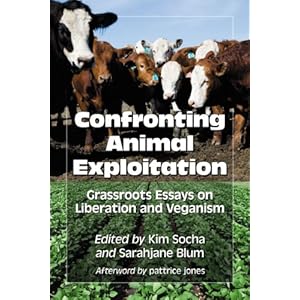
The book which contains my essay on vegan parenting is almost published. Confronting Animal Exploitation: Grassroots Essays on Liberation and Veganism should be out from McFarland Books early next year. 


I'm really excited for this book to drop. I've read most of the essays contained within and their awesomeness is matched only by their diversity. Some essays are heavy and ground-shifting while others are personal and contemplative. Here's a description of the book from McFarland. 
As animal exploitation increases, animal liberation issues are of growing concern, as seen through the rise of veganism, academic disciplines devoted to animal issues, and mainstream critiques of factory farms. Yet as the dialogues, debates and books continue to grow, the voices of "street level" activists--not academics, journalists or vegan chefs--are rarely heard on a national level. 
This volume broadens animal liberation dialogues by offering the arguments, challenges, inspiration and narratives of grassroots activists. The essays show what animal advocacy looks like from a collective of individuals living in and around Minnesota’s Twin Cities; the essayists, however, write of issues, both personal and political, that resound on a global scale. This collection provides a platform for rank and file activists to explain why and how they dedicate their time and what is being done for animals on a local level that can translate to global efforts to end animal exploitation.
Pretty cool, huh?

I'm going to start posting more snippets that I've cut out of my parenting essay on here, which I'm calling "deleted scenes" because it has a better ring to it than "essay cuts." Though these scenes won't be published, they should give you a decent idea of the sorts of themes I touch on in my essay.

In the essay, I use books and other media as examples of the barrage of speciesism our children face. Thankfully, not all books perpetuate speciesism on a readily apparent level:
Wild Talk: How Animals Talk to Each Other details the many ways that other-than-human animals communicate among one another. From the booming howels of howler monkeys to the songs of humpback whales and blinks of fireflies, the book presents conscious communication as just that. In addition to taking communication at face value, all animals in the book are either gendered or referred to as the plural “they,” as opposed to the genderless, deindividualizing "it."

Wild Talk is not an animal rights book. It doesn’t give us any guidance on how to treat animals. And there are slight improvements that would make it even more animal rights-friendly. For example, after a section in the beginning that details how we humans talk to each other, the book says, “Animals have a lot to say to each other, too.” It should, of course, say, “Other animals…” because we humans are definitely animals as well. Also, referring to the animals in the book as “wild” lumps them in an artificial category that serves to further the perceived divide between humans and other animals. But aside from those qualms, this book is a great, neutral (in that it doesn’t take a stance on any contentious issues) treatment of how other-than-human animals communicate with one another.
Just a note on the "wild animal" critique that I make there. I prefer the term suggested by Joan Dunayer, which is "free-living animal." The word "wild" reinforces the perceived normalcy and rightness of domestication in all of its forms. Free-living animals aren't wild, they're just animals, freely living in their natural habitats. By creating a category for animals who live in their natural state, we suggest that that state is just as benign and normal as the state we created for them - the domesticated and/or caged state.

And yes, I realize that "free-living" is a category in a similar way that "wild" is. The difference is that it more accurately and objectively describes the individuals we're talking about. There's a fog that needs to be cleared here and the phrase "free-living" helps in that effort.

Friday, June 10, 2011

One More Dead Wolf

On the morning of June 8th, a Mexican gray wolf escaped from his cage at the Minnesota Zoo. He walked slowly on a path, and people quickly moved away from him. The zoo staff decided that they should shoot to kill instead of tranquilize. Their rationale was that the wolf was a danger to zoo patrons and a tranquilizer dart, according to zoo officials, "can take 10-15 minutes to fully take effect on an animal."

So a choice had to be made by the zoo: either tranquilize the wolf and risk him injuring or killing patrons, or kill the wolf  and deal with the negative publicity that would be sure to follow. They chose to kill.

I have often said that if a tiger broke into my house and seemed intent on eating my children, I would not be opposed to killing her if that's what it took to save my kids. (I should note here that I would do the same if a human broke into my house and she seemed intent on eating (or just killing, I guess) my children. What I would do in this situation says nothing about what we should routinely do to animals.)

My point is, I'm not sure that the zoo necessarily made the wrong choice in this specific instance, though I think they should have more ways to catch an animal unharmed than by just using tranquilizer darts. The process they have in place for things like this should rule out killing an animal except for in the most extreme cases. Their emergency reaction plans don't take the non-human animal lives at the zoo into as much consideration as they should. But since they didn't have adequate protocol and their options were truly kill or tranquilize (as the zoo claims), I can understand why they chose kill.

The big wrong choice the zoo made was when it chose to be a zoo. Zoos are inherently unjust places, tiny pale facsimiles of animals' natural habitats, places where animals go senile, places where animals are merely a commodity to be used to entertain and, ostensibly, educate.

So in my view, the real question isn't whether or not the zoo should have shot the wolf, it's whether or not the wolf should have been there in the first place. It's obvious to me that the answer is no. We can't justify imprisioning these animals for our entertainment or even for (again, ostensibly) our education. And the fact that they escape (and they do quite a bit ... oh and let's not forget this), and then zoos are often caused to weigh the non-human animals' lives against the potential of harm to paying customers ... it seems like a recipe for disaster.

Of course, news outlets jumped all over this story. And there were plenty of outraged citizens, saying the zoo acted rashly and should have done more to capture the wolf alive. I agree. But I think it misses the point of the institutionally entrenched problem of speciesism, which allows horrible situations like this to happen.

---
That's an It. He's an It. Not a He.

On Minnesota Public Radio, they wrote:
"Zoo officials said no people were in immediate danger but they decided to shoot the wolf because they couldn't predict where it would go or whether it would hurt people visiting the Northern Trail." (link)
Elsewhere in the story, Tony Fisher, the zoo's "animal collection manager" refers to this wolf as a "he." I can't for the life of me understand why MPR would refer to him as "it." The rest of the news outlets, of course, also referred to the wolf as "it," even though he was identified as male within their stories.

The St. Paul Pioneer Press managed to gender and neuter the wolf in the same paragraph:
"The 8-year-old male wolf slipped through the gaps of a fence in the keeper area of its exhibit into a secondary enclosure where it jumped an 8-foot fence, said animal collections manager Tony Fisher." (link)
And the Star Tribune did the same thing (in fact, the combination of the words "male that" is the shortest distance possible between gendering and neutering):
"The wolf, an 8-year-old male that was born at the zoo, is one of an endangered subspecies with only a few dozen living in the wild. There were three Mexican gray wolves at the zoo, but this one was not on exhibit because it didn't get along with the other two, Fisher said." (link)
The AP went there, too. They did correctly attribute one gendered pronoun to the wolf, but then decided to neuter him anyway:
"Tony Fisher, MN Zoo animal collection manager, told KARE 11 the ordeal began around 10 a.m. when the male wolf escaped his primary display area. Vets and zookeepers armed with tranquilizers started gathering and preparing to recapture the wolf but it jumped a secondary barrier and ran out among the public walking on the zoo's Northern Trail." (link)
I've got to hand it to Tony Fisher though, in all the quotes I saw from him, he referred to the wolf by the proper pronoun. I wish the reporting media would have followed suit. I don't have my AP Style Guide handy, but I wonder if there's something in there that says you have to refer to a non-human animal as "it" even if you know his or her gender. Any reporters out there want to help me out here? Are there style guidelines on this?

This bothers me, as you can tell. Animals are not its, they are hes and shes (or in the case of hermaphroditic animals, the generic, but non-objectifying, "they"). By routinely refusing to attribute a gender to them, we reduce them to the level of things. Things are "its." We don't have to care about things. We don't really care about animals so we refer to them at "its." And we refer to them as "its" to make it easier to not care about them.

It's pervasive, it's insidious and I really, really want it to stop. Regardless of how you feel about animals, you should at least recognize them as beings who are not mere things. That recognition should be reflected in your language.

---
Precious Species, Worthless Lives

The Minnesota Zoo released a note on their Facebook page which explains why they shot the wolf instead of tranquilizing him. One of the comments on this note sums up what I think a lot of people are feeling:
"I am disappointed that this extreme action had to take place. A precious life had to end today because the zoo we support did not do its job to keep the animals safe. While I don't want to see any humans injured better safeguards should have been in place. I have been a long time member and contributor but am rethinking my support."
First of all, this extreme action didn't have to take place. This is a dilemma that was created by the zoo. If there was no zoo, this dilemma would not have existed.

Secondly, this wolf's life is no more precious than the chicken's life which became your last meal of McNuggets.

Thirdly, support for the zoo should not occur if you truly regard the lives there as precious. I know that this wolf is a member of an endangered species, but that doesn't mean his individual life is intrinsically more precious than any other animal's.

And let's not forget the reason this species is on extinction's door: human hunting of wolves. Speciesism feeds speciesism. On the one hand, humans have nearly eradicated Mexican gray wolves. On the other hand, humans are confining Mexican gray wolves in hopes of saving the species.

But what good is a species?  A species is a concept. A species doesn't have feelings. A species doesn't care if it's extinct.

What matters - who matters - are the individual members of species. But it's the individual members who are routinely confined, abused and killed. We confine them in zoos. We further encroach on their habitats with  urban sprawl. We clear-cut rain forests so we can have cheap cow flesh (and we kill cows for flesh). We kill 23 million individual chickens per day in the United States alone.

Looking at the patterns of abuse and disregard, it's obvious that the overwhelming majority of we humans could care less about individual members of species. It's almost comical to me then, that we go to such lengths to save species.

---
Anna and the Aquarium

Needless to say, my family doesn't go to zoos. The potential for escaped carnivores doesn't really come in to play when we make that choice; the right of animals to live free from ownership and exploitation does. Our sense of justice does.

That said, a few weeks ago Anna's class took a field trip to the Mall of America's underground aquarium, Minnesota Sea Life. We talked with Anna about it before hand and told her that she could go if she wants, or she could stay home. She said she wanted to go. She said she thought fish shouldn't be in cages, but she also wanted to go to see what it's like. She said she would maybe ask the people who worked there if they could let the fish go.

But she was sick that day. So she didn't go after all.

Her teacher and I were talking about it today and she said she was glad Anna wasn't there. There were a lot of dead animals that the kids could look at up close. Like a dead turtle, for example.

How many kids wondered what the turtle's life was like? What lessons did they learn by gazing upon this deceased individual's lifeless form?

What lessons did they learn by looking at the living beings trapped behind glass?

---
Further Reading


After writing this post, I looked online for critiques of zoos from an animal rights perspective. The following pieces are worth taking a look at (note: I don't necessarily endorse all views expressed on the sites at the other end of these links):

Should Zoos Keep Endangered Species? by Doris Lin
What's Wrong With Zoos? by Gary Yourofsky
Zoos by Wanda Embar at Vegan Peace

UPDATE: The Animal Rights Coalition has released a statement in regard to the shooting of the wolf. You can read it here.

Wednesday, April 23, 2008

About the Veggie Nugget I Just Posted

I have a lot of omnivorous friends and family who I love dearly. They're great people. So, when I post a veggie nugget that says, "A man can live and be healthy without killing animals for food; therefore, if he eats meat, he participates in taking animal life merely for the sake of his appetite. And to act so is immoral," I fear that these friends and family will take this as me pointing a finger at them and declaring them immoral.

I'm not a big fan of the saying "hate the sin, not the sinner", but I think in the case of what you eat and wear it can apply (though I would change the word sin to "immoral action" and sinner to "person who commits immoral act"), especially since the "sin" in this case is built into the structure of society so completely that the thought of going vegan never even crosses the majority of the population's minds.

I'm also not a big fan of declaring certain things immoral, but I think Thoreau made a good point here and I'm running with it.

I feel that eating meat and exploiting non-human animals for human gain is wrong. It shouldn't happen. This doesn't mean that I think people who aren't vegan are immoral ... just that I think they are (usually because they have inadequate or incomplete information about what they eat and wear) committing an immoral act. (I think the religious right has given the word "immoral" a bad rap and that it still has a place in civil discourse.)

I commit an immoral act when I buy a pair of pants at Target or a pair of Converse on-line, since they are made in sweat shops. I'm trying to change my purchasing habits to not only eliminate animal products, but also buy fair-labor fair-trade clothing and goods. It's a lot harder than it sounds (waaaaaaay harder than going vegan).

By the way, if any of you know of any sweat-shop-free clothing stores or on-line shops, let me know in the comments.

Monday, July 30, 2007

My Daughter is Not a Vegan


My wife and I are Vegan. We chose to become Vegan over four years ago. We believe it's the best way to eat and live. We believe that a Vegan lifestyle is the best thing for humans, animals and the earth. As such, we are raising Anna on a vegan diet. And we won't be dressing her in leather or fur. We will teach her to respect animal life. We will tell her what happens on factory farms. We will tell her how the meat industry damages the environment more than Hummers ever could. (Don't worry, we'll save the heavy stuff for when she's a teenager, and we'll also teach her by example that it's just not polite to spout grotesque realities in the presence of people who eat meat ... then again she may rebel and become very outspoken ... which would probably just make me smile;)

Yet, my daughter is not a Vegan. She is the child of Vegan parents. It's an important distinction, and one I don't take lightly. Until Anna makes the choice to become (or, gulp, not become) Vegan, she will be a child of Vegan parents.

Until she's old enough to choose Veganism, we'll raise her in the Vegan lifestyle. And we realize there may be a few "no meat under my roof" arguments. Because the fact of the matter is that we as parents have a job to do. That job is to raise our children the best way we know how. For my wife and I, that means a Vegan lifestyle.

"Vegan" is a pretty hefty label to carry on your shoulders. If we do our job as parents, Anna will grow up to be a strong individual who will be able to make an informed choice to either carry, or not carry that weight.

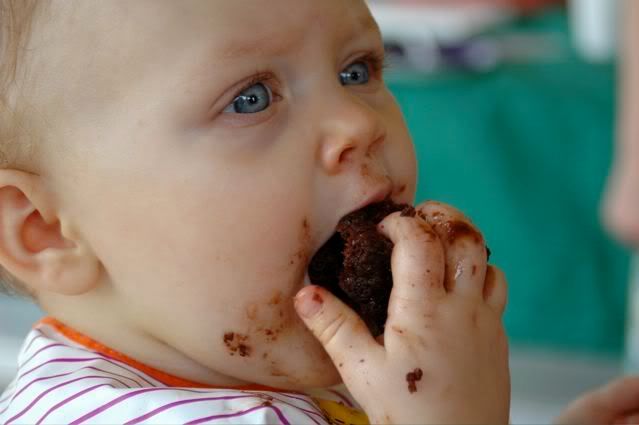
(And yes, the cake is vegan.)