
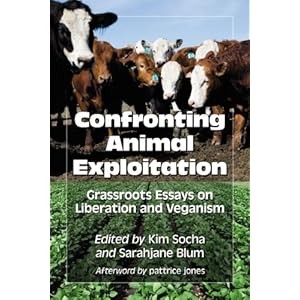
I'm really excited for this book to drop. I've read most of the essays contained within and their awesomeness is matched only by their diversity. Some essays are heavy and ground-shifting while others are personal and contemplative. Here's a description of the book from McFarland.
I'm going to start posting more snippets that I've cut out of my parenting essay on here, which I'm calling "deleted scenes" because it has a better ring to it than "essay cuts." Though these scenes won't be published, they should give you a decent idea of the sorts of themes I touch on in my essay.
In the essay, I use books and other media as examples of the barrage of speciesism our children face. Thankfully, not all books perpetuate speciesism on a readily apparent level:
As animal exploitation increases, animal liberation issues are of growing concern, as seen through the rise of veganism, academic disciplines devoted to animal issues, and mainstream critiques of factory farms. Yet as the dialogues, debates and books continue to grow, the voices of "street level" activists--not academics, journalists or vegan chefs--are rarely heard on a national level.
This volume broadens animal liberation dialogues by offering the arguments, challenges, inspiration and narratives of grassroots activists. The essays show what animal advocacy looks like from a collective of individuals living in and around Minnesota’s Twin Cities; the essayists, however, write of issues, both personal and political, that resound on a global scale. This collection provides a platform for rank and file activists to explain why and how they dedicate their time and what is being done for animals on a local level that can translate to global efforts to end animal exploitation.Pretty cool, huh?
I'm going to start posting more snippets that I've cut out of my parenting essay on here, which I'm calling "deleted scenes" because it has a better ring to it than "essay cuts." Though these scenes won't be published, they should give you a decent idea of the sorts of themes I touch on in my essay.
In the essay, I use books and other media as examples of the barrage of speciesism our children face. Thankfully, not all books perpetuate speciesism on a readily apparent level:
Wild Talk: How Animals Talk to Each Other details the many ways that other-than-human animals communicate among one another. From the booming howels of howler monkeys to the songs of humpback whales and blinks of fireflies, the book presents conscious communication as just that. In addition to taking communication at face value, all animals in the book are either gendered or referred to as the plural “they,” as opposed to the genderless, deindividualizing "it."Just a note on the "wild animal" critique that I make there. I prefer the term suggested by Joan Dunayer, which is "free-living animal." The word "wild" reinforces the perceived normalcy and rightness of domestication in all of its forms. Free-living animals aren't wild, they're just animals, freely living in their natural habitats. By creating a category for animals who live in their natural state, we suggest that that state is just as benign and normal as the state we created for them - the domesticated and/or caged state.
Wild Talk is not an animal rights book. It doesn’t give us any guidance on how to treat animals. And there are slight improvements that would make it even more animal rights-friendly. For example, after a section in the beginning that details how we humans talk to each other, the book says, “Animals have a lot to say to each other, too.” It should, of course, say, “Other animals…” because we humans are definitely animals as well. Also, referring to the animals in the book as “wild” lumps them in an artificial category that serves to further the perceived divide between humans and other animals. But aside from those qualms, this book is a great, neutral (in that it doesn’t take a stance on any contentious issues) treatment of how other-than-human animals communicate with one another.
And yes, I realize that "free-living" is a category in a similar way that "wild" is. The difference is that it more accurately and objectively describes the individuals we're talking about. There's a fog that needs to be cleared here and the phrase "free-living" helps in that effort.


