Friday, February 1, 2013

Apa's Nighttime Poem

Here's a Friday poem from Anna.

Apa's Nighttime Poem 
I love you in the morning
I love you when I'm at school
I love you in the afternoon
I love you in the evening
I'll always love you, Apa

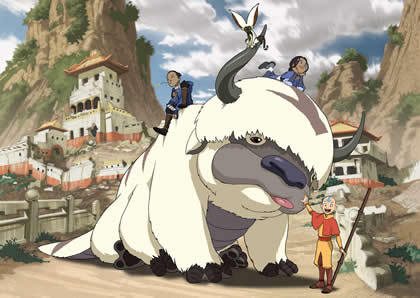
Here's Apa. He's a flying bison. He's awesome.


Anna asked for and received a stuffed Apa for Christmas from her Grandpa Ned. She looooves him. So much so that he's started to eat breakfast with us:


And when he's done with breakfast, he plays with some Legos:


And she writes love poems to him.

Thursday, January 31, 2013

Photos!

Guess what happened to my blog? Facebook, that's what!

This blog used to be the way I would communicate with my family and friends, in addition to the world at large. As such, I would put photos up from trips and holidays and all that. 

But now I'm connected with my family and friends on Facebook, so I put photos up there. And no offense world-at-large, but I just plain forget to put the photos up here, too. 

So my posts have been a bit more cerebral in nature as of late. And that's fine with me if it's fine with you. Actually, it's fine with me either way (again, no offense).

But I occasionally need to remind myself of why I started this blog in the first place. First and foremost, I wanted to show the world my healthy and happy vegan family. I wanted to show how we exist within and contribute to our culture while abstaining from certain aspects of that culture. I wanted to contribute to the normalization of veganism in general, and vegan families in specific. 

Because I do feel like part of a normal family. So normal, in fact, that the average blog reader may find us boring. Which may, in part, explain the lack of photos and posts about our familial exploits. 

Anyway, enough of that. Here's a bunch of photos taken within the last few months.

Liam with a sword.


Liam with Darth Maul's double-bladed light saber. The kids have been big into Star Wars as of late. 


Took a trip to Colorado to visit family for Thanksgiving. Here, Anna and Liam duel their older cousin Noah, who wields the double lightsaber with great skill.


First big snow of the year. Anna builds The Serpent's Pass from Avatar: The Last Airbender. That show is awesome. Jen and I loved watching it as much as the kids, if not more.


Liam bought Saesee Tiin's Starfighter with the money he got for Christmas. It was a pretty big set and he put together about 90% of it (with my help, but he put the pieces together by himself ... I just sort of directed him and helped him understand the directions).


Anna and Liam were pretending The Empire Strikes Back. Here's Anna's best "Han in carbonite" pose:


And some original lego creations. This one by Liam.


This one is Wolverine's House by Anna.


And one more by Liam. These are 100% their own creations. I love seeing what they come up with.


After a trip to the children's museum. According to Liam, one side of his face is Zuko from Avatar, and the other side is The Emperor from Star Wars. 


Anna put together one of Liam's birthday presents. That's an AT-RT.


Finally, we went to Minnehaha Falls last weekend. It was frozen and awesome. We tried getting behind the ice, because it's like Superman's fortress of solitude back there, but it was too dangerous. Maybe next time...


Hey, that wasn't so boring after all. We should do this more often!

Wednesday, January 30, 2013

Lego Birthday Party!

Liam's Lego birthday party, to be exact.

My newly four year old son loves Legos, and this is probably the last big themed party that we're going to do (actually, we never did a themed party for Anna ... Liam's Star Wars themed party last year was the first time for us, unless you count the hospital-themed birthday party they each had when they were born). So we went all out (or at least our version of "all out") and dove headlong into the theme. I've been a big fan of Legos for most of my life, so that may have something to do with my willingness to put in time and effort.

Here's a hot tip for Lego parties: Just buy yellow things and draw little smiley faces on them like this.


Kids' cups, gift bags, etc. Easy peasey.


We bought a couple lego molds online and had fun with them. The bricks on top of these cupcakes below (which are topped with the cookies and cream frosting from Vegan Cupcakes Take Over the World) look like plain chocolate, but I actually put a small layer of chocolate down in them, then a layer of crushed oreos and then another layer of chocolate. So basically, you have oreo candybars on top of a sugarbomb. We don't roll this way often, but when we do, we do it right.


And yeah, I need to perfect making candy with chocolate. I guess I need to learn how to temper chocolate?

We bought a minifigure mold, too. I made one batch of chocolate minifigures in it and then made the mistake of melting crayons in the mold (I didn't get a photo of them, but we sent two minifigure crayons home in each party bag), thinking I'd make more chocolate guys later. Well, after making the crayons, I couldn't get this white film off the mold, except for with Goo Gone, which then left a horrible orange smell (and probably toxic chemicals) on the mold. So yeah, no more edible minifigures coming out of of that mold. 


It was pretty easy to put a Lego twist on party games. This is Pin the Plunger. I built this on a baseplate, and the goal is to put a lego plunger (you know, those long skinny round pieces with a single round convex peg on the end of them? ... I really should have taken a picture of the plunger ... oh well) as close to the middle as possible. Blindfolded, of course. The winner got a little Lego set. 


Guess how many legos are in the jar. Spoiler alert: It was something like 152. Again, the winner got a little lego set or a minifigure. 


And that was it for games. Which is OK, because we brought a bunch of Legos for the kids to play with. And they did. (Megablocks for the little kids, regular Legos for the bigger kids.)


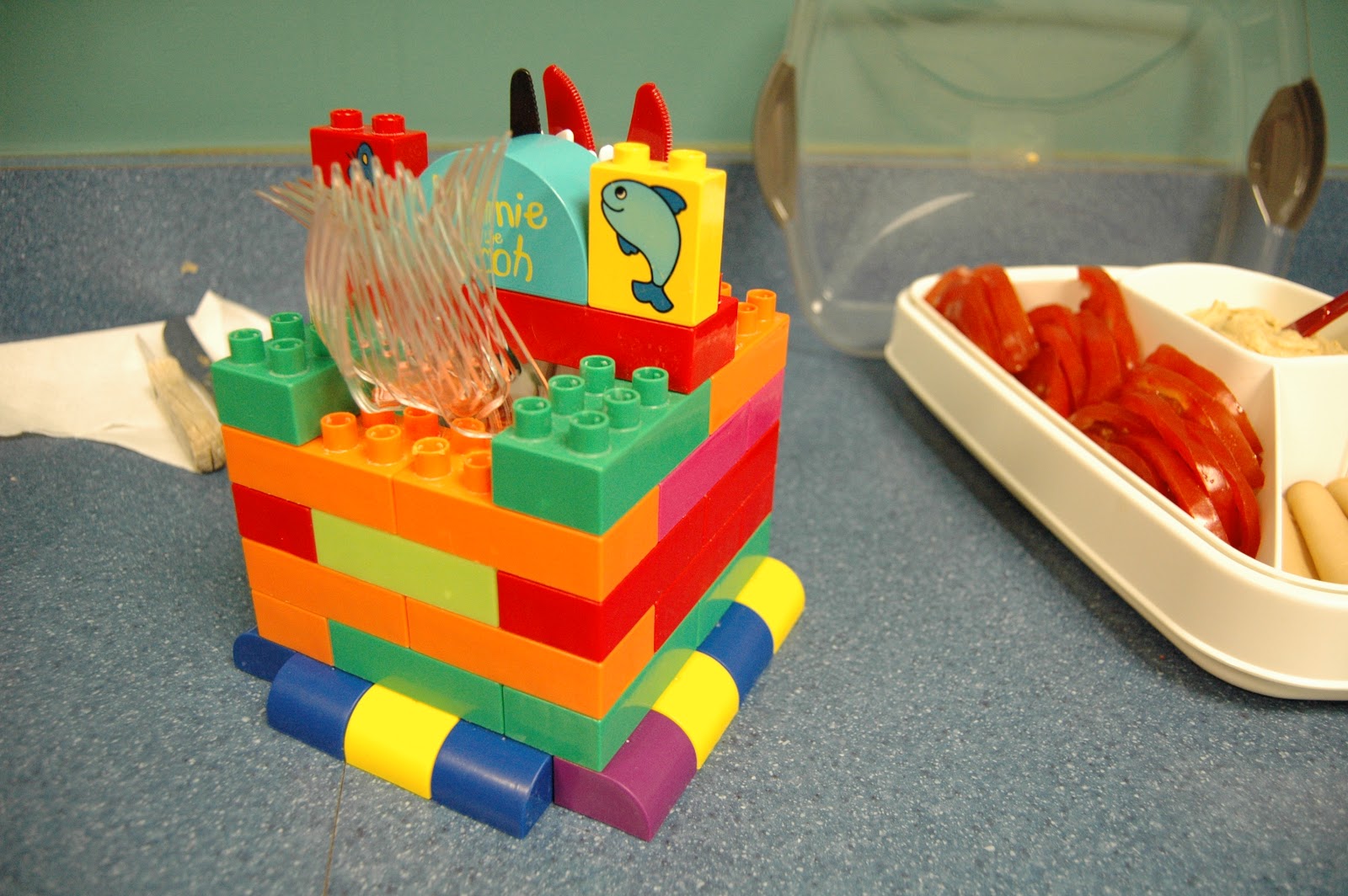
Even the utensil holder was made from blocks. Liam and I made this one together. 


The food spread. We did make-your-own bagels this year. In addition to veganizing the two recipes from here, we cut up some cucumbers and tomatoes and had some Tofurky slices. We also made a delicious Maritime Chickpea Salad (that's what I call it, since I dislike the phrase "mock tuna") from Yeah, That Vegan Shit (I smile every time I see that blog title). And some fruit, peanut butter and jelly, and babka from Breadsmith. 


What Liam looks like when everyone sings Happy Birthday to him:


What Liam looks like when he blows out all four candles from almost two feet away:


Like I said, I didn't get a photo of the party bag contents, but it was two minifigure crayons, a homemade Lego coloring book (do a google image search of "lego coloring pages" to get an idea of what was in there), and a mini Lego set.

So that was our Lego party. And now Liam's awash in new Legos and everyone's happy (including me ... because Legos are awesome). 


Um ... but with all that said, go check out this Birthdays Without Pressure page. As awesome as this party was, you really don't need to go stressing yourself all out in order to have a great time. [end of hypocritical PSA]

Sunday, January 27, 2013

Veggie Nugget #35

"Take the broad view of what veganism stands for - something beyond finding a new alternative to scrambled eggs on toast or a new recipe for Christmas cake. Realise that you're on to something really big, something that hadn't been tried until sixty years ago, and something which is meeting every reasonable criticism that anyone can level against it. And this doesn't involve weeks or months of studying diet charts or reading books by socalled experts - it means grasping a few simple facts and applying them."

-Donald Watson, founder of the Vegan Society.

That quote is from an interview with Watson which you can read here. When I feel down about the prospects of a widespread movement toward veganism, I think about Watson, who died only 8 years ago. The man invented the word "vegan."

Friday, November 16, 2012

Tour of Chicken Run Rescue

This is how time has been going for me lately. In August I wrote a review of the book City Chickens. At the end of that review, I said,
Coming soon: Photos and a re-cap of the VegKins tour of Chicken Run Rescue on July 21st. SPOILER ALERT: It will contain photos of adorable chickens and humans.
Well here we are in mid-November and I have yet to post that re-cap. Better late than never, I guess! Here are some photos (I didn't get as many as I would have liked because I was too busy managing my kids and petting chickens):

First up, our gracious host, Mary. Chicken Run Rescue is literally her and her husband's basement and back yard. The amount of good that they do with that square footage is awe inspiring and humbling.


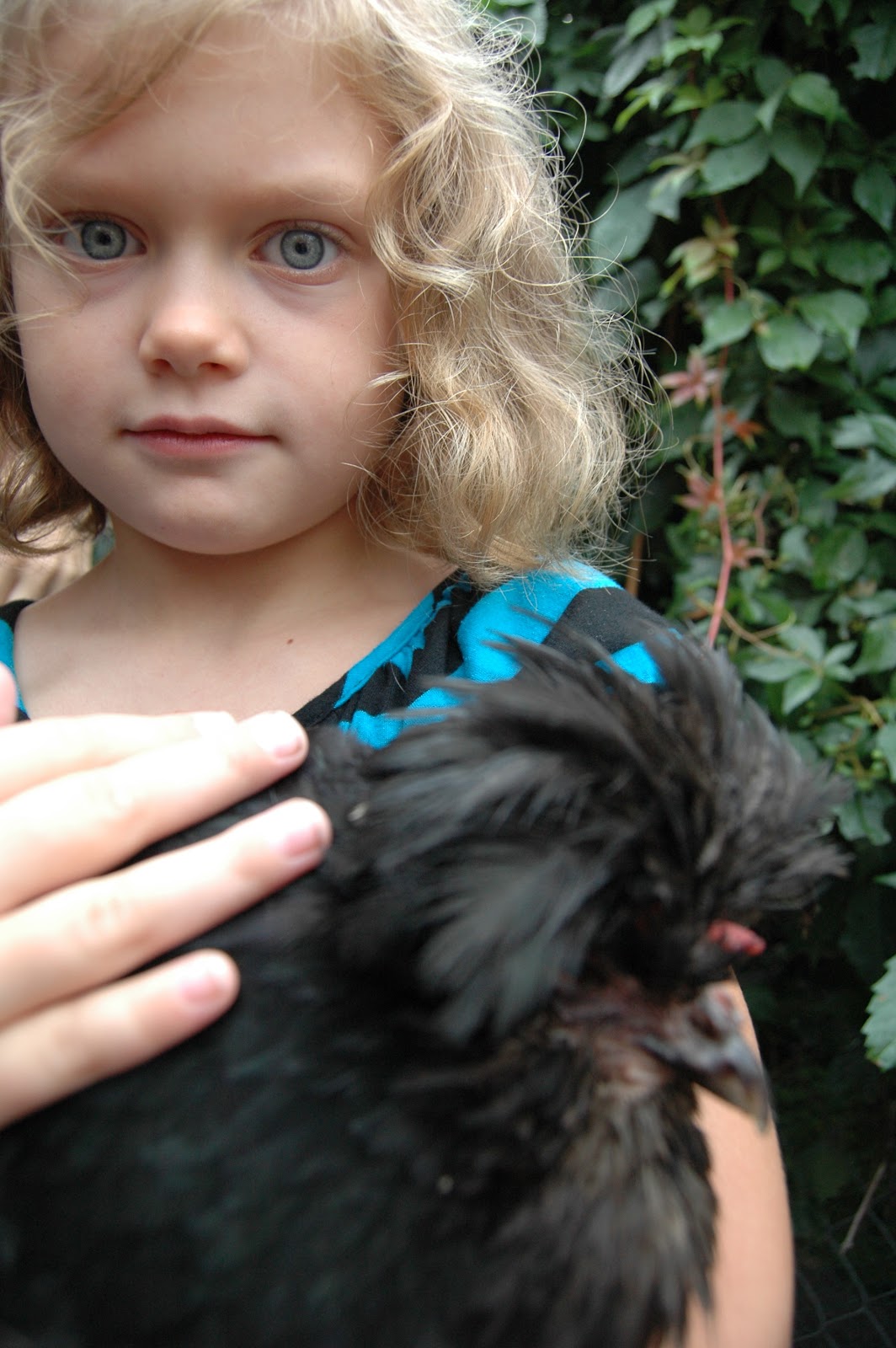
Anna wondering if this chicken would let her pick her up.


She was unsure at first (they both were).


Anna and Liam with a couple VegKins friends. VegKins (our vegan family group that meets up monthly) has blown up in the last year or so, largely because of events like this and our annual Halloween party and Spring (plastic) Egg Hunt.


Your's truly. What a rare thing it is for me to post a photo of myself on this blog.


Holy crap, here's another one of me! That's a six or seven year old Herbivore shirt that I'm wearing, by the way.


Anna eventually grew more comfortable with the chickens.


Liam never really warmed up though. Maybe next time...


All in all, it was a nourishing day. All four of us met and held chickens for the first time in our lives (Liam held one briefly, but I didn't get a photo).

I know on an intellectual level why I'm vegan. My kids know why we're raising them vegan. Meeting these birds though, really drove home a different aspect of veganism. It's one thing to say that the principle of equal consideration dictates that all sentient beings should have the right to live free from unnecessary harm and death, but it's quite another to hold a living, breathing, thinking, feeling being in your arms, stroke her feathers and scratch her head, apologize on behalf of your species, recommit yourself to never participating in the exploitation of beings like (and not like) her ... and to know that as long as you breathe you will be vegan because it matters as much as something can matter.

Thursday, November 15, 2012

Curried Squash Tomato Bisque

It's that time of year when my dad realizes that he planted waaaaay too much squash, and so he pawns it off on his more-than-willing children. Or maybe that's why he plants so much. Either way, I always get a ton of squash from my dad's garden around this time of year and I've found the perfect recipe for using a bunch of it. 

My mom made a vegan tomato squash soup a few years back for Christmas and it was delicious (yeah, my mom rocks). If I remember correctly, it was tomatoes and squash pureed together with some vegetable broth and then sauteed onions were added to it (or maybe the onions were blended in, I can't remember). She gave me the recipe and the first time I made it I taste-tested it and it wasn't as good as my mom's. Not a big surprise there. I let it sit for a while there on my stove and pondered my inadequacy. 

But instead of coming to terms with my failure in the kitchen, I decided to make the soup my own. I added a can of coconut milk to it and some curry powder, garam masala and cumin and BAM! It became something very different and very delicious. The recipe has been tweaked since then, of course. I took garam masala out of it because I ran out and didn't feel like buying more. I'm sure you could put a little in and it wouldn't hurt. And I found that it doesn't need veggie broth, though I'm sure it wouldn't hurt to have some in there if you wanted more leftovers. 

It eats like a meal. And it goes great with saltines or some good crusty bread. 

It's not every year I post an original recipe on this blog. So enjoy, dear readers:

Curried Squash Tomato Bisque

4 cups of butternut squash pulp (other kinds of squash work, too, but probably not every kind)
2 tbsp. olive oil
1 large onion chopped
1 tsp cumin seeds (or 1/2 tsp ground cumin)
28 oz can whole tomatoes with juice
15 oz can of of coconut milk
1 tsp. curry powder (start with 1, add more to taste)
1 tsp. salt
¼ tsp fresh ground pepper
1/8 tsp garlic powder
2 bay leaves

Bake squash (cut in half the long way, place in 1/4 inch of water in a casserole dish, bake at 375 until easily pierced with fork) until tender. Scrape it all out.

Heat oil on med/high heat, add cumin seeds and let them sizzle and/or pop for 30 seconds or so. Add onion and sauté until browned.

Put Tomatoes (with juice) in processor. Blend.

Add squash and onions, process until smooth (the cumin seeds won't blend up and that's fine). If you have an immersion blender, you can blend everything in the pot, but I like to used a food processor and then an immersion blender later if needed. I think it's easier to get a smoother texture that way.

Put that all in a pot, add the coconut milk and heat it up. Add curry powder, salt, pepper and garlic powder (and ground cumin if you didn't use cumin seeds back when you fried the onions). Taste and add more of any of these spices as needed. Add bay leaves and simmer for as long as you want, stirring occasionally.

I'd post a photo, but it's just orange. Close your eyes and imagine the color orange. There you go. That's what the soup looks like. 


OK fine, I'll take a quick photo with my webcam. 


See. Orange. And now you know I have a Maytag stove. 

Reheats wonderfully. Enjoy!


Wednesday, November 14, 2012

Veganism and Woo

Here's the third part of my veganism and religion essay series (parts 1 and 2 are here and here): 

What is Scientology? A cult? Religion? Despite what one wants to call Scientology, there’s no real appreciable doubt among the majority of society that it’s something rooted in an irrational, illogical, non-scientific, fantastical view of the world.

Scientologists who are vegan—people may be tempted to refer to them as vegan Scientologists—may have a “VEGAN” bumper sticker on their car alongside a “SCIENTOLOGY” bumper sticker. Will this result in non-vegan-non-Scientologists thinking that Scientology is something that vegans do, or that veganism is something that Scientologists do?

Both Scientology and veganism are on the fringe, as defined by dominant culture. Whether or not it’s true in any individual case, people who aren’t vegan will associate the other fringe aspect of a vegan’s life with veganism.

When someone voices two distinct marginalized views in a society that is indifferent or hostile toward those views, they tend to get lumped together. It’s the bumper sticker effect. It may be that veganism or the other fringe element is seen to be the dominant element about a person—one may think, “Oh, being vegan is just something Scientologists do,” or, “Oh, Scientology is just something that vegans do.” Either way, it’s a lose/lose for veganism.

It could be rightly said that I’m unfairly picking on Scientology by using them as an example. Other examples could be used, of course. I’m writing specifically about marginal systems of irrational belief here—marginal in the sense that they have a small numbers of adherents—as opposed to mainstream, culturally dominant religions. I'm not saying here that mainstream religions have some greater claim to supernatural truth than do these marginal beliefs.[1]

I focus on marginal belief systems here because they are viewed by dominant culture as on the fringe, far beyond what the average person would believe.

Given this, lumping veganism in with marginal belief systems hurts veganism. It may well be the case that the inverse is true, that the lumping hurts the marginal belief system, but that’s not my concern here. I wish to see veganism, an ethic of justice for all sentient beings, to proliferate beyond the fringe. As such, I desire to see veganism associated with the mainstream values it already reinforces. I’m not arguing that vegans should instead hitch the vegan wagon onto major religions, but that vegans shouldn’t hitch the wagon of veganism onto anything other than the idea that we should not cause the suffering and death of other-than-human animals when we don’t need to. Nothing else is required.

This argument also goes for the bumper sticker effect that is observed when raw food and other dietary restrictions, myriad new age beliefs, and “woo” are lumped in with veganism.

Regarding the extraneous dietary restrictions that get associated with veganism when vegans advocate them, vegan and registered dietitian Ginny Messina writes:
Advocating diets that incorporate unnecessary nutrition-related restrictions makes it harder for people to go vegan. That goes for fat-free, soy-free, and raw foods diets. Sometimes these variations on veganism are perceived as steps in the same dietary evolution. They aren’t. Veganism is an ethical choice and it’s a diet that is healthful and appropriate at all stages of the lifecycle. Raw foodism is a fad diet that is appropriate only for adults and is based on shaky scientific principles at best. Fatfree veganism is a therapeutic diet for adults with health problems—and as I’ve noted before, it’s not necessarily the ideal approach.
An example of someone who utilizes “woo,” which Wikipedia defines as, “a term used by scientific skeptics for pseudoscience, alternative medicine and New Age beliefs,” is advocate and author of The World Peace Diet, Will Tuttle.

Tuttle co-founded Circle of Compassion, which runs a prayer circle website. On the site, an essay Tuttle authored with co-founder Judy Carman says, “Those of us who saw the film What the Bleep Do We Know? learned, or probably already knew, that our thoughts create energy fields that can affect matter in powerful ways.”

This is what is meant by “woo.” Aside from utilizing junk science and selectively interpreting good science in order to propagate a spiritual worldview, What the Bleep Do We Know? has intractable ties to a sect which believes that a woman, Judy “JZ” Knight, channels a 35,000 warrior named Ramtha.

The claims made in the movie are not supported by science.

Tuttle and Carman continue,
What we are proposing is that we all increase the power of these [animal advocacy] actions exponentially by uniting our focused thoughts on this single phrase at least once a day: “Compassion encircles the earth for all beings everywhere.” Imagine this phrase—this vision—being brought into the minds and hearts of millions of people each and every day and thus generating an energy field of compassion around the world.

I have to wonder why, if this sort of thing works, Tuttle and Carman don’t ask people to focus their thoughts on this phrase multiple times per day, or perhaps focus their thoughts on nothing but this phrase all day long. (I know that Tuttle does not do this, himself. He's a tireless advocate for peace, touring all over the place in order to spread the message of radical inclusiveness detailed in his book, The World Peace Diet.)

This concept that Tuttle and Carman put forth is, of course, similar to the Christian concept of the power of prayer: Pray, and Jesus will answer. Again, I’m not claiming that one way is closer or less close to the “right way.” That’s not the point I’m making here.

The Catholic concept of a wafer magically turning into the flesh of a god because an ordained man in a robe says some words to it is pretty darn out there when you step back and look at it. But the fact remains that Catholics are a respected demographic in our culture. One can’t simply say, when trying to determine how best to advocate on behalf of other-than-human animals, that since the majority of society believes in an all-powerful spiritual being or beings, then statements like the ones Tuttle and others make in regard to vegan advocacy should be treated as just another way of viewing our spiritual relation to reality.

Put another way, in the public relations fight between Jesus and Ramtha, Jesus is winning by a lot, and his odds are great to keep on winning for the foreseeable future. I happen to think that vegans shouldn’t bet on either of them, but if you do bet on the one who has little to no odds of winning, maybe just … keep it to yourself while advocating for other-than-human animals?

Carman and Tuttle write that their books, “can help you educate people about how activism and spiritual work are inextricably linked with animal rights issues. For example, world peace and personal inner peace cannot be attained among human beings as long as we are violently dominating, exploiting, and eating our animal kin.”

I agree with the second sentence, but I wonder what inner and world peace have to do with spiritual work. Spirituality is the belief in non-physical things. Inner peace and world peace are real, physical matters. I need no spiritual belief in order to advocate on behalf of animals and I take offense at the claim that I do.[2]

Veganism requires no more faith than is required when we see a dog yelping in pain and say, “That dog is in pain.”[3] There’s a preponderance of scientific evidence to back up that claim of pain. On the other hand, there’s a poverty of scientific evidence to suggest that merely thinking about something can change it, or that a woman can channel a 35,000 year old warrior, or that raw foods are always healthier than cooked foods, or that oil has no place in healthy diets.

Vegans may do well to keep a large gap between their advocacy of veganism and their advocacy of other fringe beliefs and actions, especially when those beliefs and actions are supported neither by the culture at large or by anything close to the scientific evidence which supports veganism.

[1] For what it’s worth, if I were to make a claim at all in this regard, I would claim that all supernatural claims are equally, patently false.
[2] I am aware of the humor of this statement, considering that it appears within a piece sure to offend many people.
[3] Substitute any animal you want for “dog” in this statement, including “human.”

Monday, November 12, 2012

Coming Soon: Confronting Animal Exploitation -- and another Deleted Scene

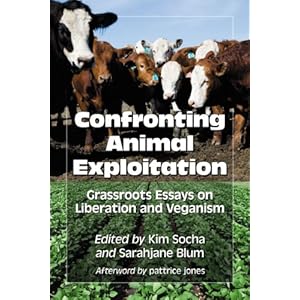
The book which contains my essay on vegan parenting is almost published. Confronting Animal Exploitation: Grassroots Essays on Liberation and Veganism should be out from McFarland Books early next year. 


I'm really excited for this book to drop. I've read most of the essays contained within and their awesomeness is matched only by their diversity. Some essays are heavy and ground-shifting while others are personal and contemplative. Here's a description of the book from McFarland. 
As animal exploitation increases, animal liberation issues are of growing concern, as seen through the rise of veganism, academic disciplines devoted to animal issues, and mainstream critiques of factory farms. Yet as the dialogues, debates and books continue to grow, the voices of "street level" activists--not academics, journalists or vegan chefs--are rarely heard on a national level. 
This volume broadens animal liberation dialogues by offering the arguments, challenges, inspiration and narratives of grassroots activists. The essays show what animal advocacy looks like from a collective of individuals living in and around Minnesota’s Twin Cities; the essayists, however, write of issues, both personal and political, that resound on a global scale. This collection provides a platform for rank and file activists to explain why and how they dedicate their time and what is being done for animals on a local level that can translate to global efforts to end animal exploitation.
Pretty cool, huh?

I'm going to start posting more snippets that I've cut out of my parenting essay on here, which I'm calling "deleted scenes" because it has a better ring to it than "essay cuts." Though these scenes won't be published, they should give you a decent idea of the sorts of themes I touch on in my essay.

In the essay, I use books and other media as examples of the barrage of speciesism our children face. Thankfully, not all books perpetuate speciesism on a readily apparent level:
Wild Talk: How Animals Talk to Each Other details the many ways that other-than-human animals communicate among one another. From the booming howels of howler monkeys to the songs of humpback whales and blinks of fireflies, the book presents conscious communication as just that. In addition to taking communication at face value, all animals in the book are either gendered or referred to as the plural “they,” as opposed to the genderless, deindividualizing "it."

Wild Talk is not an animal rights book. It doesn’t give us any guidance on how to treat animals. And there are slight improvements that would make it even more animal rights-friendly. For example, after a section in the beginning that details how we humans talk to each other, the book says, “Animals have a lot to say to each other, too.” It should, of course, say, “Other animals…” because we humans are definitely animals as well. Also, referring to the animals in the book as “wild” lumps them in an artificial category that serves to further the perceived divide between humans and other animals. But aside from those qualms, this book is a great, neutral (in that it doesn’t take a stance on any contentious issues) treatment of how other-than-human animals communicate with one another.
Just a note on the "wild animal" critique that I make there. I prefer the term suggested by Joan Dunayer, which is "free-living animal." The word "wild" reinforces the perceived normalcy and rightness of domestication in all of its forms. Free-living animals aren't wild, they're just animals, freely living in their natural habitats. By creating a category for animals who live in their natural state, we suggest that that state is just as benign and normal as the state we created for them - the domesticated and/or caged state.

And yes, I realize that "free-living" is a category in a similar way that "wild" is. The difference is that it more accurately and objectively describes the individuals we're talking about. There's a fog that needs to be cleared here and the phrase "free-living" helps in that effort.

Thursday, September 20, 2012

Conversion Narrative in Veganism


The following is part two of a three-part series I wrote quite a while back. There was a chance that these were going to be published in an upcoming anthology in which a separate essay (by me) having nothing to do with religion will appear, but it didn't pan out (nobody's fault and no hard feelings). Honestly, I'm sort of OK with these mini-essays not being published, since they are sure to irk people in a way that I don't necessarily feel comfortable irking. 

The previous essay in this series, Religion and Vegan Advocacy, received a couple comments that deserve a response. I plan to write a separate post addressing these and any other comments I get on this second installment and the eventual third installment. 

OK. Here's the essay now. 

Oh wait, one more thing. If these essays had actually made it to the point of being published, I can assure you that they would have been edited and re-edited and fleshed out and would just be plain better (because my editors are rock-stars, that's why). So ... now that I've sufficiently lowered expectations, here you go!


The words “convert” and “conversion” come up a lot when vegans talk about choosing to be vegan. In many ways, this makes sense. In others, it’s problematic.

In what way is this conversion narrative a positive?

First, it’s something that just makes sense. Everyone knows what conversion means: in the simplest sense, it’s changing from one thing to another. When non-vegans choose to be vegan, that’s a type of conversion. Often, it can feel like a religious conversion; something akin to a spiritual awakening. As one blogger writes:

People often ask me why I made the decision to go vegan. I can point to certain events leading up to that moment that are helpful in explaining how I got here, but at the same time, when I really think about it, it’s almost as if it wasn’t a choice at all … What I mean is that it was almost like I had been asleep before and suddenly I woke up and saw the cruelty and suffering around me; being vegan seemed like something I simply had to do. 

I’m sure that many vegans can relate to this. I know I can.

This blogger may not have used the word “conversion,” and maybe that was intentional on her part, but the above quote still falls under the umbrella of what I mean when I refer to conversion language.

One could imagine Paul—formerly Saul—saying something similar about his conversion on the road to Damascus: “All of a sudden, I saw a light and I woke up.”

Sentiments such as these are all over the internet. One blog, The Vegan Light Bulb, has the tag line, “Stop looking at the shadows and look into the light!” Another blog is called My Vegan Awakening. James McWilliams even has a "Vegan Conversion Narrative" series on his blog.[1]

The word conversion is apt when describing the change from one ideology to another, and so I submit that the use of the word when talking about the change to veganism is technically correct. When one chooses to be vegan, it could be said that they are rejecting the ideology of speciesism and embracing equal consideration of other-than-human animals. Veganism could be said to be the ideology of this embrace.

That said, it’s important to consider what problems arise from use of the conversion narrative.

By framing veganism as a conversion, vegans present veganism as something ideologically different from what non-vegans believe. Conversion language doesn’t give enough weight to that fact that many people already agree, to an extent, with the precept that unnecessary killing of animals is wrong. The conversion narrative presents veganism as an ideology that is wholly different from the way non-vegans already view animals, but in many cases, this is not true.

The word conversion is also closely—perhaps intrinsically—tied to religion in our culture. For reasons that I state in my post, Religion and Vegan Advocacy, I see this as a problem.

Another pitfall of the conversion narrative is that most people don’t want to be converted. Most people are happy with who they are. When a non-vegan hears a vegan talking about their conversion, they may see it as this odd metaphysical shift instead of a simple decision made for rational reasons; reasons the non-vegan may likely be able to identify with.

If the problems of the conversion narrative outweigh the positives, and I think they do, then what easy-to-understand alternative could vegans use when describing their transition to veganism?

Carol Adams has used a different term to describe the act of becoming vegan in her book Living Among Meat Eaters. She refers to non-vegetarians as “blocked vegetarians”[2] and the process of becoming vegetarian as becoming “unblocked.” Living Among Meat Eaters is obviously a book geared toward people who already eschew animal flesh (a point Adams reinforces within the book), but it’s worth asking whether or not vegans should use the blocked/unblocked language when speaking to non-vegans.

Non-vegans may bristle at the notion that they’re blocked and somehow less connected to their minds than vegans are. Additionally, this term has caused a few vegans I know to refer this the book as a little too “woo” for their liking, meaning that its language takes on a new age feel and/or seems to be rooted in nonscientific thought.

If “unblocked” seems to exchange religion for woo—which may work for some, but not for others—then what other word or phrase could be used to talk about our transitions to veganism?

Vegans may appeal to a broader set of people when, instead of using conversion language, they say something like, “I chose to be vegan because…” This frames our actions simply as a choice.

It’s true that “conversion” also denotes a choice, but it carries baggage. It also suggests, because of its close association with religion, that vegans substitute one faith-based way of thinking with another faith-based way of thinking.

Veganism is a rational choice that most people are capable of making. Framing that choice as a conversion, though, may keep them from seeing it that way.

[1] This essay was written before McWilliams started the "Vegan Conversion Narrative" series, so that name and the name of this mini-essay is nothing more than coincidence. I just decided to add a reference to his series in at the last minute here since it seemed to fit so well. 
[2] In this book, Adams uses the word “vegetarian” to refer to vegetarians and vegans.

Thursday, August 2, 2012

City Chickens


City Chickens by Christine Heppermann tells the tale of Chicken Run Rescue – the only urban chicken rescue in the United States – just across the river from me in Minneapolis, MN.

Chicken Run Rescue is run by Mary Britton Clouse and Burt Clouse. The book tells the stories of how Mary and Burt came to care deeply about other-than-human animals as children, and eventually how they came to be the founders and caregivers of Chicken Run Rescue. Their stories are a short section of the book, but one that matters so, so much. This world cannot have enough examples of people handing their lives over to care for other animals. Everyone—young and old, vegan and non-vegan—can learn something profound from the dedication and care Mary and Burt unleash upon the world.

City Chickens also does a fantastic job of telling the unique stories of several chickens who have come through the gates of Chicken Run Rescue. From Billiam, a rooster who was dumped on the side of the road with 105 other chicks; to Miss Manor, the hen who Burt rescued from the grounds of an apartment complex (for an uplifting and heartbreaking photo tour of Miss Manor’s rescue and care, see this photo album on the Chicken Run Rescue Facebook page). 

"Now she would have a warm place to sleep, fresh food and water, plenty of space to explore. Now Bert would hold her and hum softly while Mary attended to her wounds."

There’s a ton of information and images packed into this book. In my opinion, the design suffers as a result. In order to break up large chunks of text, certain sentences are given a different and larger font. As a former newspaper reader (sorry, newspaper industry!), I’ve been trained to assume that larger text within smaller text is a pull-quote and is not meant to be read in sequential order (or read at all, if you’re already reading the whole story). It’s safe to say that the design took some getting used to on my part.

What the book may lack in design, though, it more than makes up for in photos. The layout might not be perfect, but since, according to the publisher, this is a book for kids ages 6-9 (I think that top age range should go all the way to 13 31 103, especially given the importance of the subject matter), more photos equals more connections. These birds are beautiful beings and the multitude of photos does a great job of capturing that beauty.

A note of warning to parents: There are three of what I would consider disturbing photos. One of a rooster who was rescued after police shut down a cockfighting operation, and two others of hens in battery cages. Probably not nightmare inducing images, but it depends on the kid (and adult). 

This is unavoidably a book about the refugees and casualties of humanity’s war of indifference on other animals. As such, you can expect to read about some of the horrible things that are done to chickens. The words are not graphic, but they’re there. One cannot talk about a sanctuary without talking about what it’s a sanctuary from. And Chicken Run Rescue is a sanctuary, even if only a temporary one for most guests. Thankfully, the homes these chickens end up in after adoption are also places that treat them as someones, not somethings – as an end unto themselves, not a means to another’s end – as beings with intrinsic worth above and beyond any extrinsic worth afforded to them.  

The few graphic images and depictions of cruelty are certainly not necessary in order to educate our kids about animal rights, but they do portray the awful reality of countless chickens. Personally, I let my kids see the images and explain them with the tact and love they require. And then we move on again to the happy parts of the book.

This is a long book and it's full of heavy ideas and situations. I suggest reading it with your kid(s) in shifts, explaining things along the way. Even with older kids, I think reading it together, at least for the first time, is a good idea. It's definitely a conversation starter. Don't be surprised if your kids ask if you can adopt a chicken. Don't be surprised if you seriously consider it. 

---

Here are two videos taken at Chicken Run Rescue. The first is from Minnesota Public Radio and the second is shot by a Minneapolis based animal advocate. 


And apparently I'm just not that good at the internet, because I cannot for the life of me embed a Vimeo video on this blog. Yes, I tried the embed code. Anyway, click on this link here and it'll take you to the video. 

Coming soon: Photos and a re-cap of the VegKins tour of Chicken Run Rescue on July 21st. SPOILER ALERT: It will contain photos of adorable chickens and humans.